Most buyers spend weeks choosing the grade and the glass, then pick the finish in five minutes. That is a pity, because stainless steel railing finishes decide how the railing looks on day one, how it looks after three winters, and how easy it is to fix a scratch. They also decide whether two batches of parts from two suppliers will match on site. At UNIKIM we polish and brush railing hardware every day in our Ningbo factory, and finish questions come up on almost every order. This guide explains the common options in plain terms, so you can choose with your eyes open.
Why stainless steel railing finishes matter more than people think
A finish is not just a look. It is the shape of the surface at a very small scale. A rough surface has tiny grooves, and grooves hold salt, dirt and water. A smooth surface sheds them. As a result, the same AISI 316 post can stay bright for years with one finish and show brown marks within a season with another.
The finish also affects maintenance. For example, a brushed handrail hides fingerprints well and can be touched up with an abrasive pad. A mirror handrail shows every print, and a deep scratch on it usually means sending the part back for repolishing. So the right choice among stainless steel railing finishes depends on who uses the railing, how often it is cleaned and where it stands.
Finally, stainless steel railing finishes affect price and lead time. Mirror polishing takes more labour than brushing, and coloured coatings add another process step. None of this is a problem if you plan for it. It only becomes a problem when the finish is decided late.
The main stainless steel railing finishes, one by one
Finish names are a mess in our industry. One supplier’s “satin” is another’s “brushed”, and “polished” can mean almost anything. The numbered finishes come from the ASTM A480 standard for flat stainless steel, which is a useful common language. Below is how we describe the main stainless steel railing finishes to customers.
Mill finish (2B): the starting point
2B is the smooth, slightly cloudy grey surface that sheet and coil have when they leave the mill. It is clean and fairly smooth, but it looks unfinished on a railing. You will rarely see it on visible parts. However, it is common on hidden parts such as backing plates, inner sleeves and brackets that sit inside a base cover.
No. 4 brushed finish
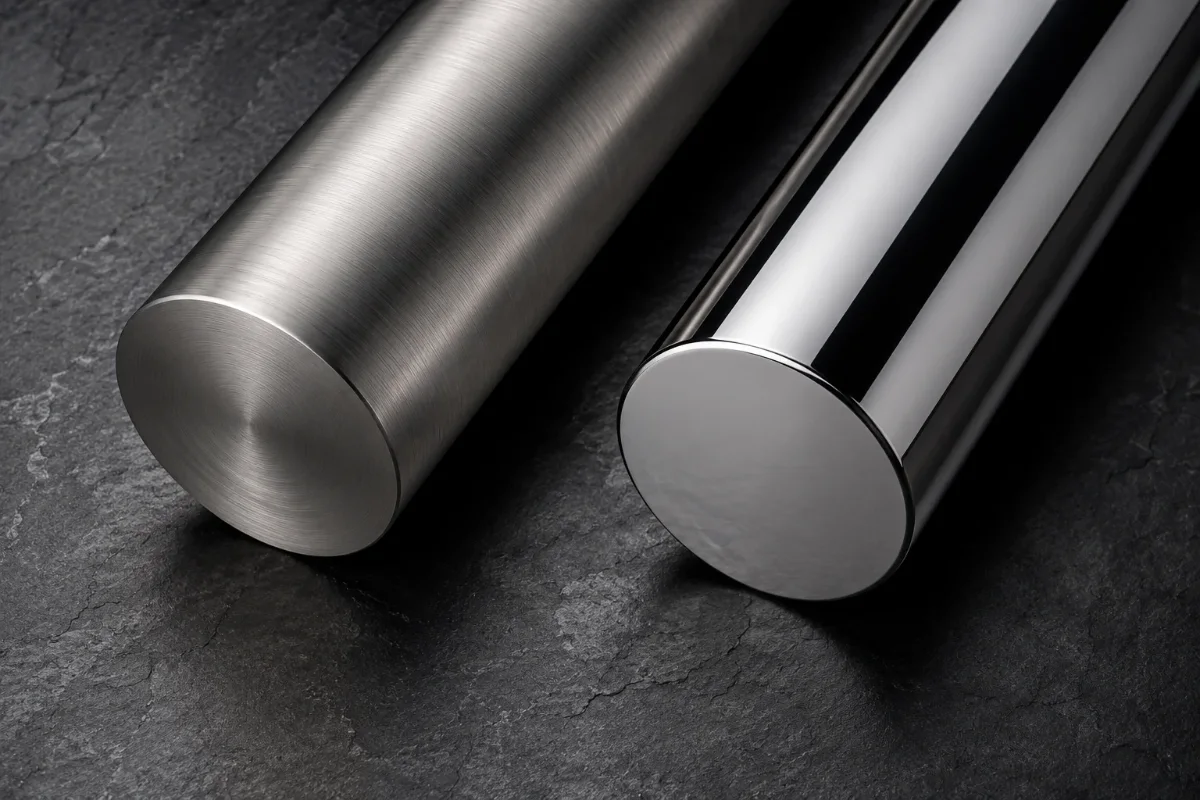
No. 4 is the most common of all stainless steel railing finishes. The factory grinds the surface with fine abrasive belts, usually around 150 grit, which leaves straight, even lines in one direction. It has a soft sheen rather than a shine.
In practice, No. 4 is the safe choice for most posts, handrails, spigots and clamps. It hides light scratches and fingerprints. It is also easy to repair on site, because a matching abrasive pad drawn along the grain blends a scratch back in. The weak point is the grain itself. Coarse lines hold more salt, so near the sea a finer brush, or regular washing, is important.
Satin finish
Satin is a finer, softer brushed look. The lines are shorter and less visible, and the surface feels smoother to the hand. Many suppliers make it with non-woven abrasive pads after the main grinding step. Because there is no strict standard for “satin”, always ask for a sample before you approve it.
We like satin for handrails that people touch every day, and for interior work where a gentle look suits the design. Outdoors it performs a little better than a coarse No. 4, simply because the surface is smoother.
Mirror polished finish (No. 8)
A mirror finish is polished in several stages until the surface reflects like glass. It looks striking on hotel lobbies, shop fronts and frameless glass balustrades, where the hardware should read as jewellery. If you want that look, our guide to luxury glass railing shows how designers use it.
Of all stainless steel railing finishes, mirror is the smoothest, so it gives salt the least to hold on to. That makes it a good choice by the sea, as long as somebody cleans it. The downside is honesty. Every fingerprint, water spot and scratch shows. A deep scratch cannot be hidden with a pad, and on-site repolishing rarely matches the factory finish.
Electropolished finish
Electropolishing is an electrochemical process that removes a very thin layer from the surface. It smooths the peaks left by grinding and leaves a bright, clean surface that is rich in chromium. Therefore, it improves corrosion resistance as well as looks. Specifiers often choose it for coastal and pool parts, and on cable fittings with many small corners that are hard to polish by hand.
It adds cost, and factories usually do it as an extra step after brushing or polishing. Among stainless steel railing finishes, it is a choice for the harshest sites, not a default.
PVD coloured finishes: black, gold, bronze and more
PVD (physical vapour deposition) puts a very thin, hard coating on the steel in a vacuum chamber. It gives colours such as black, gold, rose gold, bronze and champagne, while the stainless steel underneath does the structural work. The coating copies the texture below it. So a PVD part on a brushed base looks brushed, and on a mirror base looks glossy.
Black is the colour we are asked for most often now. Our matte black railing systems article covers that trend in detail. One honest point: a PVD coating cannot be touched up on site. If a black clamp gets a deep scratch, the part has to be replaced. Some black parts are powder coated rather than PVD coated, so ask your supplier which process a given part uses.
Stainless steel railing finishes compared side by side
The table below sums up how common stainless steel railing finishes behave on real railings. It is a guide, not a lab result, and it assumes the same grade of steel underneath.
| Finish | Look | Hides scratches and prints | Outdoor and coastal use | Site repair | Relative cost |
|---|---|---|---|---|---|
| 2B mill | Dull grey | Fair | Fair | Not needed (hidden parts) | Lowest |
| No. 4 brushed | Straight grain, soft sheen | Very good | Good with washing; coarse grain holds salt | Easy with matching pad | Low |
| Satin | Fine, soft grain | Very good | Good | Easy with fine pad | Low to medium |
| Mirror (No. 8) | High gloss, reflective | Poor | Very good if cleaned | Difficult | Medium to high |
| Electropolished | Bright, clean | Good | Excellent | Difficult | Medium to high |
| PVD colour | Black, gold, bronze, etc. | Good on brushed base | Good on 316 base | Not possible; replace part | High |
Which stainless steel railing finishes work outdoors?
Outdoors, the grade comes first and the finish second. AISI 316 should be the starting point for anything near the sea, a pool or a road that uses de-icing salt. Our guide to 304 vs 316 stainless steel explains why. Once the grade is right, stainless steel railing finishes decide how well the steel keeps clean.
The rule is simple: smoother is better. The Australian Stainless Steel Development Association, which studies coastal corrosion closely, recommends smooth finishes for marine work, and its technical guidance at ASSDA is worth reading for any coastal project. A coarse brushed finish on 316 can still look poor if salt sits in the grain for months. On the other hand, a fine satin, mirror or electropolished surface rinses clean in the rain.
Brown marks on outdoor stainless steel are usually tea staining, not real rust. Our article on stainless steel tea staining explains the causes and the fix. In short, the right grade, a smooth finish and regular washing prevent most of it.
Choosing stainless steel railing finishes for interiors
Indoors, corrosion is rarely the issue. Instead, the questions are about looks, cleaning and wear. For example, a busy office stair or a shopping centre handrail gets touched thousands of times a day. Brushed or satin finishes suit these spots because they hide fingerprints and light scratches.
Mirror finishes work best where people look more than they touch. Think of glass clamps on a balcony edge, spigots on a lobby balustrade or a feature stair in a showroom. PVD colours suit design-led interiors, where the hardware has to match door handles, light fittings or window frames.
Our page on glass railing specification explains how to write stainless steel railing finishes into a project spec so there is no argument later.
Matching finishes across a project
This is where many projects go wrong. A railing is a set of parts: posts, handrails, brackets, clamps, end caps and covers. If they come from different suppliers, or from different batches, stainless steel railing finishes can look different side by side. Brushed parts are the worst for this, because grain depth and direction vary.
Here is what we tell customers to check before ordering:
- Ask for physical samples of the finish, not photos.
- Approve one “master sample” and keep it on site.
- Specify the grain direction on brushed parts (usually along the length of the tube or post).
- Order all visible parts of one area from one supplier, in one batch, where possible.
- For PVD colours, ask for a sample from the same production lot.
Small parts are easy to forget. End caps, for example, are often bought last and from whoever has stock. Our guide to stainless steel railing end caps covers those details.
Caring for stainless steel railing finishes
All stainless steel railing finishes last longer with simple care. Wash with warm water and mild soap, rinse with fresh water, and dry with a soft cloth. On brushed and satin parts, always wipe along the grain. Wiping across it leaves swirl marks that catch the light.
There are a few things you should never use. Steel wool and wire brushes leave iron particles that rust on the surface. Chloride bleach and hydrochloric acid attack stainless steel. Abrasive cleaners will dull a mirror finish and can strip a PVD colour. The Nickel Institute publishes clear guidance on cleaning stainless steel in different environments.
How often to clean depends on the site. Indoors, a wipe during normal cleaning is enough. By the sea, washing exposed parts every few weeks keeps salt from building up. Sheltered spots under roofs and balconies need the most attention, because rain never rinses them.
What changes the price of a finish
Buyers often ask why two quotes for the same clamp can differ. The finish is a big part of the answer. Here are the main cost drivers:
Labour. Mirror polishing goes through more stages than brushing, and each stage takes skilled time. Small, complex parts such as cable fittings take longest.
Extra processes. Electropolishing and PVD are separate steps, often with their own minimum batch sizes.
Rejects. High-gloss and coloured finishes show every flaw, so more parts fail inspection. That cost is built into the price.
Packing. Mirror and PVD parts need more careful packing to arrive without marks.
When you compare suppliers, compare the same finish on the same grade. A cheap “polished” part is often a light brush with a little shine, and it will not match a true mirror finish next to it.
Why work with UNIKIM
UNIKIM has more than 20 years of experience making stainless steel railing hardware in Ningbo, China. We supply posts, handrail supports, glass spigots, glass clamps and fittings in AISI 304 and 316, with brushed, satin and mirror finishes, plus black options, to distributors, contractors and fabricators around the world. We also make OEM parts to customers’ own drawings and finish samples. You can browse our glass clamps, stainless steel railing posts and matte black design range, or see more of our factory on the UNIKIM Made-in-China store.
FAQ
The No. 4 brushed finish is the most common. It has fine straight lines and a soft sheen, hides fingerprints and light scratches, and is easy to touch up on site. For most posts, handrails and fittings it is the safe choice. Among stainless steel railing finishes, it gives the best balance of looks, cost and easy care for everyday projects.
A smooth polished surface usually stays cleaner outdoors, because salt and dirt have fewer grooves to sit in. However, it shows marks more easily. A fine satin brush is a good middle ground. Whatever you choose, use AISI 316 near the sea or a pool, because the grade matters more than any of the stainless steel railing finishes on top of it.
On brushed and satin finishes, yes. A matching abrasive pad drawn along the grain blends most light scratches back in. Mirror finishes are much harder to repair on site, and the result rarely matches the factory polish. PVD colours cannot be repaired; the part has to be replaced. This is worth knowing when you compare stainless steel railing finishes for busy areas.
A good PVD coating is hard and bonds well, so it resists normal handling and cleaning. Still, it is very thin. Deep scratches from keys, tools or abrasive cleaners can cut through it, and it cannot be touched up on site. Clean it with mild soap and water only.
Summary
Stainless steel railing finishes shape how a railing looks, how it ages and how easy it is to keep. No. 4 brushed and satin finishes are practical, forgiving choices for most projects. Mirror and electropolished finishes stay cleanest outdoors but show every mark. PVD colours add design options but cannot be repaired on site. Choose the grade first, then the smoothest finish that suits the use, and approve physical samples before ordering. UNIKIM manufactures AISI 304 and 316 railing hardware in brushed, satin, mirror and black finishes. To match a finish to your project, contact our team.