Spigot vs standoff is one of the first choices in any frameless glass railing project. Both systems hold glass at a few points, so the view stays open and the hardware stays small. However, they fix to different places, need different glass and suit different buildings. Choosing the wrong one can mean drilled glass that does not fit or a floor that cannot take the anchors. At UNIKIM we make both spigots and standoffs in our Ningbo factory, so this guide compares them in practical terms.
What is a glass spigot?
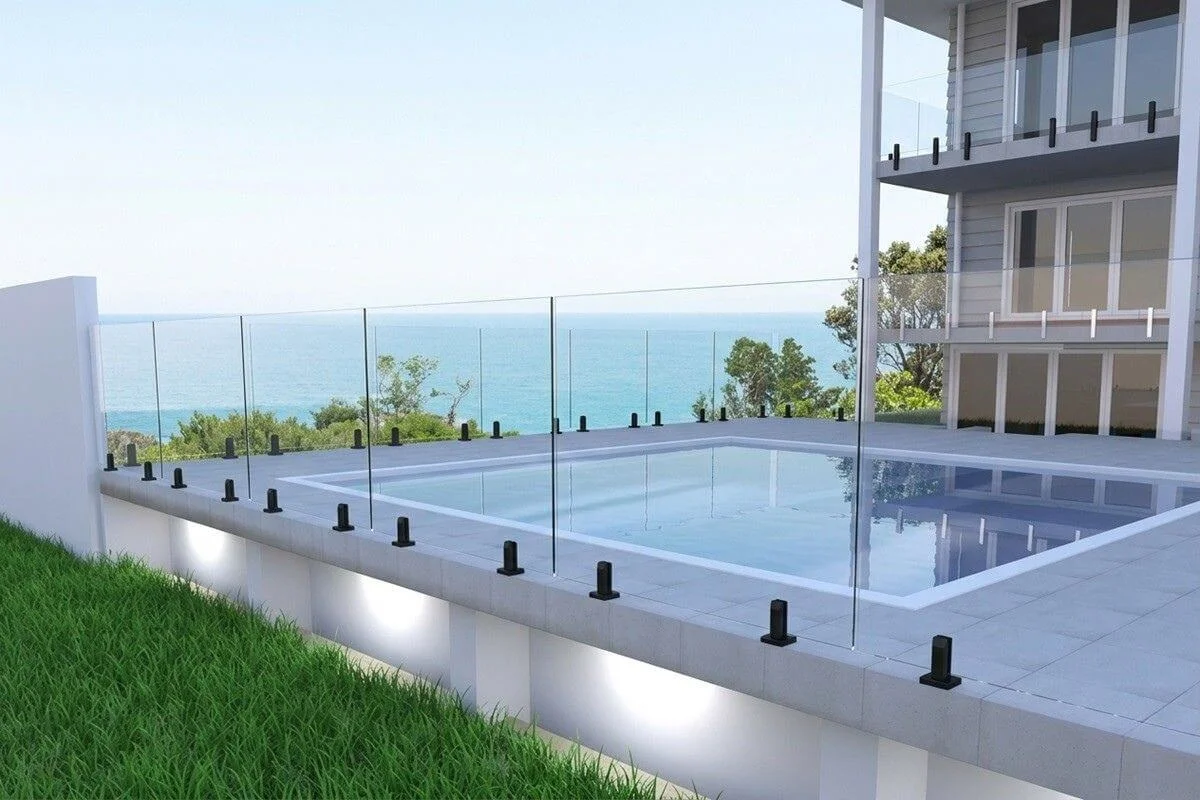
A glass spigot is a short stainless steel post that clamps the bottom edge of a glass panel. It stands on the floor, either on a base plate fixed with anchors or core-drilled into a hole in the concrete. The glass sits in a slot at the top and is held by a clamp plate with rubber insert.
Spigots are the classic choice for pool fences, decks and terraces. For example, our round glass spigot MOD 6000 has a Ø48 mm post on a Ø103 mm base plate and comes in 150, 160 and 180 mm heights in AISI 316. Our spigot glass railing guide explains how the system works in more detail.
What is a glass standoff?
A glass standoff fixes a glass panel to the side of a slab, stair stringer or wall. A bolt passes through a hole in the glass and into the structure, and a round or square head clamps the glass on the outside face. A barrel keeps the glass a set distance away from the edge, which is why it is called a standoff.
Standoffs make the glass look as if it floats in front of the building. Our square glass standoff MOD 2921, for instance, is a 50 × 50 mm block for 8 to 17.52 mm glass. The glass standoff range also includes round heads from Ø30 to Ø70 mm and adjustable versions.
Spigot vs standoff: the main differences
The table below sums up the spigot vs standoff choice at a glance. After that, each point is explained in more detail.
| Factor | Glass spigot | Glass standoff |
|---|---|---|
| Where it fixes | On top of the floor or deck | To the side of the slab, stringer or wall |
| Glass holes | Usually none; the glass is clamped | Holes drilled in the glass before toughening |
| Floor space | Takes a little space on the walking surface | Leaves the floor completely clear |
| Look | Small posts along the bottom edge | Glass floats in front of the edge |
| Typical uses | Pool fences, decks, terraces, interior balconies | Balcony edges, stairs, mezzanines, façades |
| Adjustment on site | Good; panels can be packed and aligned | Limited; holes must line up exactly |
| Structure needed | Sound floor or slab for anchors | Strong slab edge or stringer face |
Spigot vs standoff: fixing and structure
The biggest difference is where the load goes. A spigot passes the guard load down into the floor through its anchors. Therefore, the slab or deck must be thick and strong enough near its edge. On timber decks, blocking under the spigot is usually needed.
A standoff passes the load sideways into the edge of the slab or the stringer. As a result, the slab edge must be solid and deep enough for the anchors. Hollow blocks, thin cladding or weak render are not suitable fixing points. In practice, many standoff projects need a steel angle or plate cast into the edge.
Either way, the anchors and their spacing come from the project’s structural design. Our guide to glass railing load requirements explains which loads the fixings must carry.
Glass for spigot and standoff railings
Both systems use toughened or laminated safety glass. In the United States, Section 2407 of the International Building Code, Chapter 24 sets the rules for glass in guards, including the glass type and the safety factor. Our glass railing code requirements checklist sums up the main points.
The glass work is different, though. Spigot glass is usually clamped without holes, so panels can be ordered and fitted quickly. Standoff glass, by contrast, needs holes drilled before the glass is toughened, because toughened glass cannot be drilled afterwards. Consequently, standoff projects need accurate site measurements and careful drawings before the glass is made.
Laminated glass is the safer choice for both systems on balconies and public buildings. If one ply breaks, the interlayer holds the glass in place until it can be replaced. Our article on laminated vs tempered glass explains the difference.
Spigot vs standoff: look and design
Spigots leave the edge of the slab visible and put small posts along the floor. On a pool fence or deck, that look is clean and familiar. In addition, the gap under the glass makes cleaning easy.
Standoffs show the glass in front of the edge, with round or square heads as the only visible metal. Designers like this on modern balconies and stairs, because the floor finish runs right to the edge. However, the heads become a design feature, so their size and finish matter. Brushed stainless steel suits most façades, while matte black heads suit darker frames.
Spigot vs standoff on stairs
Stairs show the difference between the two systems clearly. With spigots, each fitting stands on a tread or on the stringer top, and the glass follows the pitch above it. As a result, the spigots must be set at the right heights, and the treads must be strong enough near the open edge.
Standoffs often suit stairs better. They fix to the face of the stringer, so the treads stay clear and the glass follows the stair as one clean line. However, raked glass panels with drilled holes need very accurate templates. A small error in the stair angle can stop the holes from lining up.
In both cases, stairs also need a graspable handrail. You can fix it to the glass with clamps or to the wall. Our guide to frameless glass stair railing shows the common details.
Installation: which is easier?
Spigots are usually faster to install. The installer fixes the spigots, sets the glass, packs it level and tightens the clamps. Small errors can be corrected on site, because nothing is drilled through the glass.
Standoffs need more preparation. The holes in the slab edge must line up with the holes in the glass, so the installer works to tight tolerances. On the other hand, once the setting-out is right, the glass goes up quickly and needs no floor work at all. Our glass standoff fittings guide covers sizes, spacing and setting-out.
Maintenance for spigot and standoff railings
Both systems need very little care, but a simple routine keeps them looking good. First, clean the glass and the stainless steel with mild soapy water, then rinse with fresh water. Near the sea or a pool, rinse more often, because salt and chlorine leave deposits that can stain the steel.
Next, check the fixings once a year. On spigots, make sure the clamp screws are tight and the rubber inserts are still in place. On standoffs, check that the heads are tight and the washers between steel and glass are not worn.
Finally, never use steel wool or chloride bleach on stainless steel. These can scratch the surface or start corrosion. A soft cloth and a stainless steel cleaner are enough for most marks.
Cost: spigot vs standoff
Neither system is always cheaper. The final price depends mostly on the glass and the structure.
- Glass: standoff glass needs drilled holes and accurate templates, which adds cost.
- Hardware count: both systems use a small number of fittings per panel, but standoffs often need more fixing points.
- Structure: core-drilling a slab for spigots, or adding steel plates to a slab edge for standoffs, can change the budget a lot.
- Access: standoffs on a high slab edge may need scaffolding or a lift.
- Finish and grade: AISI 316 costs more than 304 but is essential outdoors near salt or chlorine.
For a full breakdown, see our guide to glass railing cost per linear foot.
Which should you choose?
Choose spigots when the floor is strong, the floor space is not critical and you want a fast, adjustable installation. They are the natural choice for pool fences, decks and terraces. Our glass pool fence spigots guide covers the extra pool rules.
Choose standoffs when you want the floor completely clear and the glass in front of the edge. They suit balcony edges, stairs and mezzanines with a solid slab edge or stringer. Furthermore, they work well where the floor finish must run to the edge without interruption.
Grade matters for both. Use AISI 316 stainless steel for outdoor, coastal and pool projects, because it resists chlorides much better than 304. The Australian Stainless Steel Development Association publishes useful guidance on stainless steel care in these conditions.
Why choose UNIKIM for spigots and standoffs
UNIKIM has more than 20 years of experience making stainless steel railing hardware in Ningbo, China. We manufacture glass spigots, glass standoffs, clamps and handrail fittings in AISI 304 and 316, so one supplier can cover both systems on the same project. Distributors, contractors and fabricators order from us with OEM and wholesale supply. Browse the glass spigot range to compare base-plate, core-drilled and side-mount options.
FAQ
In the spigot vs standoff choice, the main difference is where the hardware fixes. A spigot stands on the floor and clamps the bottom edge of the glass. A standoff fixes to the side of the slab or stringer, with a bolt through a hole in the glass. As a result, spigots use a little floor space, while standoffs leave the floor completely clear.
Both can meet code loads when they are designed and installed correctly. Strength depends on the glass, the number of fittings, the anchors and the structure behind them. So the spigot vs standoff question is less about strength and more about where your building can safely take the load: the floor or the slab edge.
Yes. Standoffs pass a bolt through the glass, so the holes must be drilled before the glass is toughened. That means accurate templates and site measurements are essential. Spigots, by contrast, usually clamp the glass without holes, which is one reason the spigot vs standoff choice affects lead time.
Spigots are the usual choice for pool fences. They stand on the pool deck, clamp the glass without holes and are easy to adjust. Choose AISI 316 stainless steel, because pool water contains chlorides. In the spigot vs standoff comparison, standoffs suit pool areas only where a solid wall or edge is available.
It depends on the project. Standoff glass needs drilled holes and accurate templates, which adds cost. Spigots may need core-drilling or extra blocking in the floor. For most decks and pool fences spigots cost less, while on a strong slab edge the spigot vs standoff cost difference can be small.
Summary
The spigot vs standoff choice comes down to where your structure can take the load and how you want the glass to look. Spigots stand on the floor, clamp the glass without holes and install quickly, so they suit pool fences, decks and terraces. Standoffs fix to the slab edge, keep the floor clear and make the glass float, so they suit balconies and stairs. In both cases, use laminated glass where codes require it and AISI 316 stainless steel outdoors. UNIKIM manufactures both spigots and standoffs in its Ningbo factory. To compare options for your project, contact our team with drawings and quantities.