
Stainless steel tea staining is the light brown discoloration that appears on railings, balustrades and fittings, usually near the sea or a pool. Owners often call it rust and worry that the railing is failing. In most cases it is a surface stain, not a structural problem. However, if nobody deals with it, the stain spoils the look and can turn into small pits. At UNIKIM we make stainless steel railing hardware in our Ningbo factory, so this guide explains why tea staining happens, how to remove it and how to stop it coming back.
What is stainless steel tea staining?
Stainless steel stays bright because of a very thin chromium oxide layer on its surface. This passive layer repairs itself as long as oxygen reaches the steel. Tea staining starts when salt or other chlorides settle on the surface and stay there. As a result, the passive layer breaks down in tiny spots, and a brown film forms.
The name comes from the colour, which looks like a tea stain on a cup. The Australian Stainless Steel Development Association describes tea staining as a common, mostly cosmetic form of discoloration on stainless steel in coastal and polluted areas. Its guidance on the ASSDA website is a good reference for architects and owners.
Why railings turn brown: the main causes
Tea staining rarely has one cause. In practice, it appears when several factors come together.
Chlorides in the air or water. Sea spray carries salt far inland on windy days. Pool water, cleaning products and de-icing salt bring chlorides too. Chlorides are the main trigger for staining on stainless steel.
The wrong grade. AISI 304 works well indoors and in mild climates. However, it has no molybdenum, so it resists chlorides less well than AISI 316. Near the sea or a pool, 304 often stains within a season. Our guide to 304 vs 316 stainless steel explains the difference in detail.
A rough surface. Coarse brushed or ground finishes have tiny grooves. Salt and dirt sit in these grooves and are hard to wash away. Smoother finishes give salt less to hold on to.
No rain washing. Rain rinses salt off exposed surfaces. Railings under a roof, a balcony soffit or a canopy never get that natural rinse. Consequently, sheltered parts often stain first.
Contamination during fabrication or installation. Grinding carbon steel nearby, or using steel wool and carbon steel tools on stainless parts, leaves iron particles on the surface. These particles rust and look like tea staining. Our list of railing hardware installation mistakes covers how to avoid this.
Is tea staining the same as rust?
Not exactly. Tea staining is a thin surface discoloration, while rust usually means the base metal is corroding. On a correctly chosen stainless steel railing, tea staining does not reduce strength in the short term.
That said, it should not be ignored. Where chlorides stay on the surface for a long time, small pits can form under the stain. Pits are harder to clean and can hold more salt. Therefore, regular cleaning matters more than many owners expect.
How to tell stainless steel tea staining from other brown marks
Not every brown mark on a railing is tea staining. Before you clean, it helps to know what you are looking at, because each problem needs a different fix.
Stainless steel tea staining is an even, light brown film, often heaviest on the side facing the sea or in sheltered corners. It usually wipes back to bright steel with a stainless steel cleaner.
Iron contamination shows as small orange or brown spots, often in clusters. These come from steel dust, grinding sparks or carbon steel tools. The spots may return after cleaning until every iron particle is removed. In that case, a professional clean and passivation are often needed.
Pitting looks like tiny dark dots that stay after cleaning. If you run a fingernail over the surface, you may feel small holes. Pitting means the stain was left too long, or the grade is not right for the site. Light pits can sometimes be polished out, but deeper pits mean the part should be replaced with AISI 316.
Rust from other metals can also run onto stainless steel. For example, a rusty bracket, screw or nearby steel beam can drip brown water onto a clean railing. Check the parts above and around the stain before blaming the stainless steel.
Which railing parts show stainless steel tea staining first
Some parts of a railing system are more exposed than others, so they need extra attention.
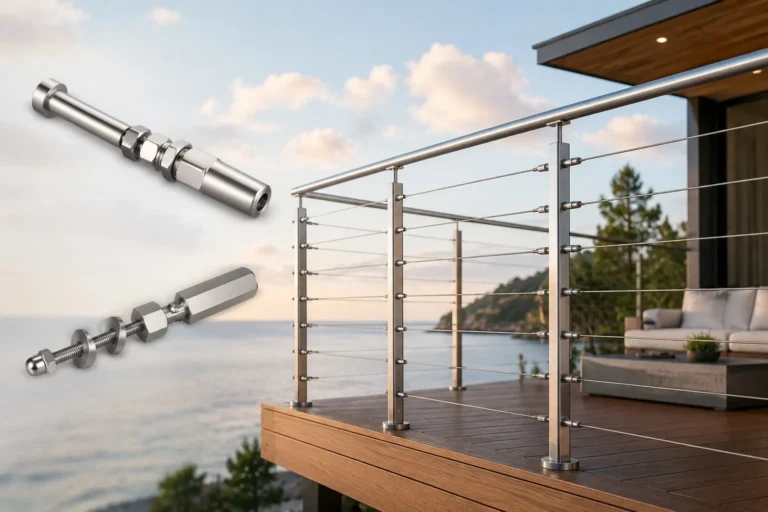
Cable and cable fittings have many small wires and crevices where salt collects. Therefore, cable railings near the sea need AISI 316 and more frequent rinsing. Our guide to maintaining stainless steel cable railing covers this in detail.
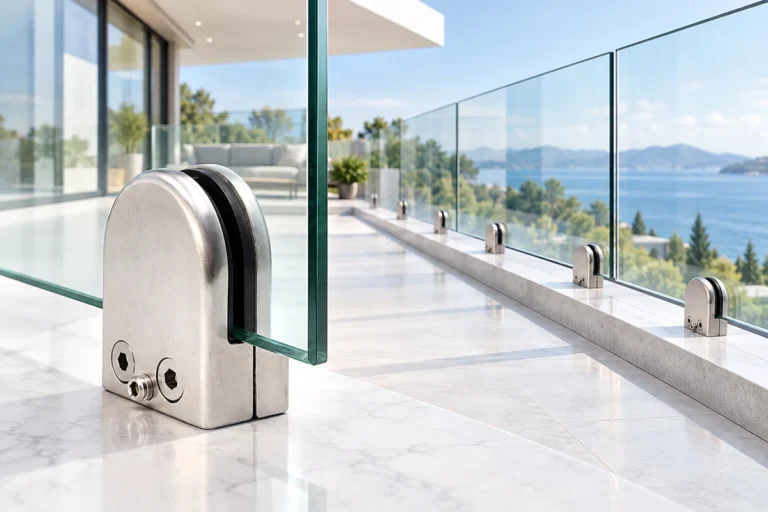
Glass spigots and clamps sit close to the floor or pool deck, where splash water and cleaning products collect. In addition, the gap between glass and steel can trap water.
Handrails are touched every day. Hand oils and dirt hold salt on the surface, so handrails often show stains along the top.
Base plates and fixings sit where water collects and dries slowly. Covers and caps also hide small gaps that are easy to forget during cleaning.
Where stainless steel tea staining appears most
Some places are much more exposed than others.
- Coastal homes and resorts. Balconies, terraces and walkways facing the sea get the most salt spray.
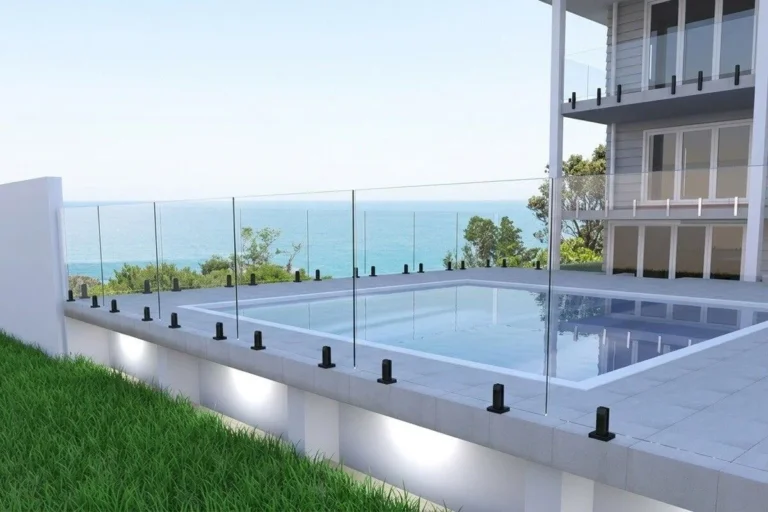
- Pool fences and pool decks. Chlorinated water and pool chemicals splash onto spigots and posts. Our article on pool chemicals and glass spigots explains the effect on hardware.
- Sheltered areas. Railings under roofs and soffits miss the rain that would rinse them.
- Roads and car parks. De-icing salt in cold climates reaches nearby railings.
- Industrial areas. Polluted air can also deposit aggressive particles.
For projects near the sea, our guide to the best railing systems for coastal areas compares the options.
How to remove stainless steel tea staining from railings
Most stainless steel tea staining comes off with gentle cleaning. Start with the mildest method and only move on if the stain stays.
1. Rinse and wash. Wash the surface with warm water and a mild detergent, then rinse with fresh water. Dry it with a soft cloth. 2. Use a stainless steel cleaner. For stains that remain, use a cleaner made for stainless steel. Many contain a mild acid, such as phosphoric acid, that lifts the brown film. 3. Follow the grain. On brushed finishes, wipe along the direction of the polish lines. Wiping across the grain can leave marks. 4. Rinse thoroughly. Always rinse the cleaner off with fresh water, so no residue stays on the steel. 5. Consider passivation for heavy staining. A specialist can apply a passivation treatment to restore the passive layer. Industry practice for this treatment is described in the ASTM A967 standard.
Just as important is what not to use. Never use steel wool, wire brushes or carbon steel scrapers, because they leave iron particles that rust. Avoid chloride bleach and hydrochloric (muriatic) acid, since they attack stainless steel. For more cleaning tips, see our guide on how to maintain stainless steel glass balustrades.
How to prevent stainless steel tea staining
Preventing stainless steel tea staining is cheaper than cleaning it. Most of it is decided before the railing is ordered.
| Factor | Higher risk | Lower risk |
|---|---|---|
| Steel grade | AISI 304 outdoors near sea or pool | AISI 316 for coastal and pool areas |
| Surface finish | Coarse brushed or ground finish | Smooth satin or mirror polish |
| Design | Crevices, gaps and ledges that trap salt | Smooth shapes that drain and rinse easily |
| Exposure | Sheltered from rain | Open to rain, or washed by hand |
| Cleaning | Rarely or never | Regular washing with fresh water |
| Fabrication | Carbon steel tools and grinding nearby | Clean, separate stainless steel tools |
Choose AISI 316 outdoors. Its molybdenum content gives much better resistance to chlorides. For pool fences, coastal balconies and roads that use de-icing salt, 316 should be the default.
Specify a smooth finish. A finer finish leaves fewer grooves for salt to sit in. Ask your supplier which finish suits your site.
Design out water traps. Avoid crevices, overlapping plates and ledges where salt water collects. Drain holes and sealed joints help.
Plan regular washing. Near the sea, wash exposed stainless steel with fresh water every few weeks, and more often in sheltered spots. The Nickel Institute publishes useful guidance on stainless steel care in different environments.
Keep parts clean on site. Store stainless parts away from carbon steel work, and use separate tools.
Why work with UNIKIM
UNIKIM has more than 20 years of experience making stainless steel railing hardware in Ningbo, China. We supply posts, glass spigots, clamps and fittings in AISI 304 and 316, with brushed and polished finishes, to distributors, contractors and fabricators worldwide. For coastal and pool projects we recommend AISI 316. Browse our glass spigots and stainless steel railing posts for 316 options.
FAQ
Stainless steel tea staining is caused mainly by chlorides, such as sea salt or pool chemicals, staying on the surface. A rough finish, the wrong grade and no rain washing make it worse. Iron particles from carbon steel tools can cause similar brown marks. In most cases, the stain sits on the surface and can be cleaned off.
Usually not. Stainless steel tea staining is a thin surface discoloration, not deep corrosion. It does not weaken a correctly chosen railing in the short term. However, if chlorides stay on the surface for years, small pits can form. Clean the stain early and wash the railing regularly to prevent damage.
Wash with warm water and mild detergent first, then rinse with fresh water. For stains that remain, use a cleaner made for stainless steel and wipe along the grain. Rinse well afterwards. Never use steel wool, chloride bleach or hydrochloric acid, because they make stainless steel tea staining and corrosion worse.
It can, but much less than 304. AISI 316 contains molybdenum, which improves resistance to chlorides. Near the sea or a pool, 316 is the right choice, yet it still needs regular washing. A smooth finish and good design reduce stainless steel tea staining on 316 even further.
Wash exposed coastal railings with fresh water every few weeks, and more often in sheltered areas that rain does not reach. Pool railings also benefit from a regular rinse. This simple routine removes salt before it can cause stainless steel tea staining and keeps the steel bright.
Summary
Stainless steel tea staining is a common, mostly cosmetic brown film caused by chlorides, rough finishes, sheltered positions and contamination. It usually cleans off with mild detergent and a stainless steel cleaner, as long as you avoid steel wool and chloride bleach. The best prevention is to choose AISI 316 outdoors, specify a smooth finish, design out water traps and wash the railing regularly. UNIKIM manufactures AISI 304 and 316 railing hardware in its Ningbo factory. To discuss the right grade and finish for your project, contact our team.