Ask three suppliers for a quote and you may get three different words for the same part. One calls it a spigot, another a post, a third a glass clamp. That confusion costs time, and sometimes it costs money when the wrong part arrives on site. This glass railing glossary explains the words that come up most often, in plain English. At UNIKIM we make glass railing hardware in our Ningbo factory, so these are the terms we use with distributors, contractors and architects every day.
The terms in this glass railing glossary are grouped by topic rather than A to Z, because it is easier to understand a spigot when you read it next to a base shoe and a standoff. Use the headings to jump to the part you need.
Glass railing glossary: glass and glazing terms
Annealed glass. Ordinary float glass that has not been heat treated. It breaks into large, sharp pieces, so it is not used on its own in railings.
Tempered glass (toughened glass). Glass heated and then cooled quickly, which makes it about four to five times stronger than annealed glass of the same thickness. When it breaks, it shatters into small, blunt pieces. However, a broken tempered panel falls out of its fixings, which is why many guards now use laminated glass instead.
Heat-strengthened glass. Glass heated and cooled more slowly than tempered glass. It is about twice as strong as annealed glass and breaks into larger pieces. Because of this, it is often laminated in pairs, so the broken panel keeps some stiffness.
Laminated glass. Two or more glass sheets bonded to a plastic interlayer. If the glass breaks, the pieces stay stuck to the interlayer and the panel stays in place. Our guide to laminated vs tempered glass explains the trade-offs.
PVB interlayer. Polyvinyl butyral, the most common interlayer in laminated glass. It is flexible and works well where the glass is held along an edge.
Ionoplast interlayer (SGP). A much stiffer interlayer than PVB. It keeps a broken laminated panel standing better, so it is popular for frameless guards with no top rail.
Heat soak test. An extra oven test for tempered glass. It aims to break panels that contain nickel sulfide inclusions in the factory instead of on your balcony. It reduces the risk of spontaneous breakage but does not remove it completely.
Low-iron glass. Glass with less iron, so it looks clearer and less green at the edges. Designers therefore choose it where the glass edge is on show.
Polished edge. A glass edge ground and polished smooth and shiny. It is the usual finish for exposed edges on frameless railings.
Glass railing glossary: fixing and hardware terms
Most confusion in quotes comes from hardware names. For that reason, this part of the glass railing glossary is the longest.
Base shoe (U-channel). An aluminium or stainless steel channel fixed to the floor or slab edge, with the glass held along its whole bottom edge. Our guide to the aluminum base shoe covers the types and sizes.
Dry glaze. A way of fixing glass in a base shoe with wedges, shims or a rubber clamping system instead of grout. It allows panels to be adjusted and replaced.
Wet glaze. Fixing glass in a base shoe with grout or cement and then sealing the top with silicone. It is strong, but it makes replacing a broken panel much harder.
Spigot. A short stainless steel post that clamps the bottom of a glass panel. Usually two spigots hold each panel. In the UK and Australia, a railing on spigots is often called a spigot balustrade.
Core-drilled spigot. A spigot with a long stem set into a hole drilled in concrete and grouted in. It leaves no visible base plate.
Base-plate spigot. A spigot welded to a plate that is bolted to the floor. In most designs, a cover hides the bolts.
Standoff (glass pin). A round stainless steel fitting that bolts through a hole in the glass into the side of a slab, stair or wall. It holds the glass away from the surface. Our article on spigot vs standoff glass railing compares the two.
Glass clamp. A small fitting that holds the edge of a glass panel and fixes it to a post, wall or another panel. For example, clamps come flat, angled or for round posts. See our glass clamps range.
Glass-to-glass connector. A fitting that joins two panels at an angle or in a straight line, without a post between them.
Glass adapter. A round fitting that fixes a handrail or other part to the face of the glass through a drilled hole.
Rubber gasket (insert). The soft lining inside a clamp, spigot or base shoe. It protects the glass from metal and sets the grip on a given glass thickness.
Slot tube (cap rail). A round or square tube with a slot along its underside. It slides over the top edge of the glass, ties the panels together and serves as a top rail.
Top rail. A rail fixed along the top of the glass. However, a top rail is not always a handrail; its main job is often to hold the line of the guard if a panel breaks.
Handrail. A rail meant to be held by the hand for support. Codes set its height, size and grip shape.
Wall flange. A plate that fixes a handrail or top rail to a wall.
End cap. A cover that closes the open end of a tube.
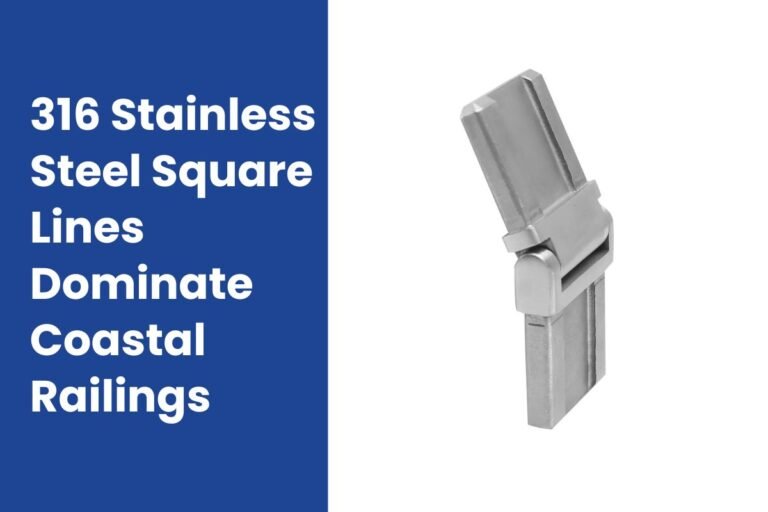
Elbow and joint. Fittings that connect lengths of tube at corners, changes of angle or straight joins.
Glass railing glossary: structure and code terms
This part of the glass railing glossary uses US code terms, because our main markets are the USA and Canada. Other countries use similar ideas, although the numbers differ.
Guard (guardrail). A barrier that stops people falling from a raised edge, such as a balcony, stair or deck. It is different from a handrail, although one rail can do both jobs.
Balustrade. The British and Australian word for a guard, including its posts, infill and rail. In this glass railing glossary, balustrade and guard mean the same thing.
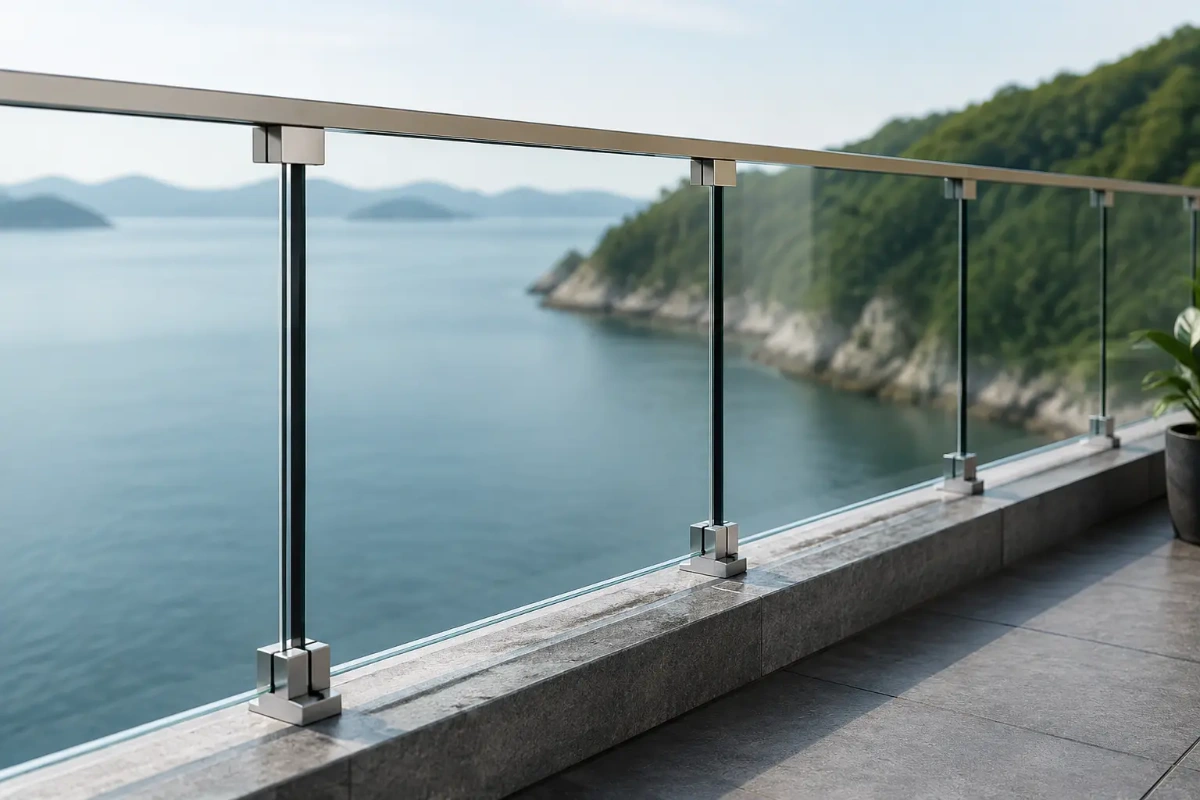
Infill. The part of a guard between the floor and the top rail. In a glass railing, the infill is the glass.
Guard height. The minimum height of a guard. In the United States, the International Building Code generally asks for 42 inches, while the International Residential Code allows 36 inches for most homes. Our guide to glass railing code requirements gives the details.
4-inch sphere rule. A US code rule that a 4-inch sphere must not pass through any opening in a guard.
Concentrated load. A single point load a guard or handrail must resist. In the US, the International Building Code, Chapter 16 sets 200 pounds applied in any direction at the top.
Uniform load (line load). A load spread along the length of the top rail, given per foot or per metre. Our article on glass railing load requirements explains how loads and glass thickness relate.
Deflection. How far the glass or rail bends under load.
Structural glass. Glass that carries load itself, as in a frameless guard where the glass holds the rail rather than the other way round. Section 2407 of the International Building Code, Chapter 24 covers glass in guards and handrails.
Glass railing glossary: installation terms
In practice, these words appear on drawings and method statements. So the installation part of the glass railing glossary is worth reading even if you never pick up a drill.
Substrate. The material the railing is fixed into, such as concrete, steel or timber. As a result, it decides the anchor type.
Top mount. Hardware fixed on top of the floor or deck surface.
Side mount (fascia mount). Hardware fixed to the vertical face of a slab, beam or stair stringer. It keeps the walking surface clear.
Chemical anchor. A bonded anchor set in resin, often used for spigots and base plates in concrete.
Embedment depth. How deep an anchor or core-drilled spigot goes into the substrate. It comes from the anchor maker’s data and the engineer.
Edge distance. The distance from an anchor to the edge of the slab. For this reason, anchors placed too close to an edge can crack the concrete.
Shim. A thin packer used to level a base plate or adjust glass in a dry-glaze base shoe.
Setting block. A small hard rubber block that the glass sits on, so it never touches metal.
Plumb. Truly vertical. Glass panels are adjusted until they are plumb and in line.
Glass railing glossary: material and finish terms
Finally, these terms describe the steel itself. As a result, they decide how the hardware looks and lasts, and no glass railing glossary would be complete without them.
AISI 304. The most common stainless steel grade for railing hardware. It suits dry indoor areas and mild climates.
AISI 316. Stainless steel with added molybdenum for better resistance to chlorides. It is the right choice near the sea, pools and roads that use de-icing salt.
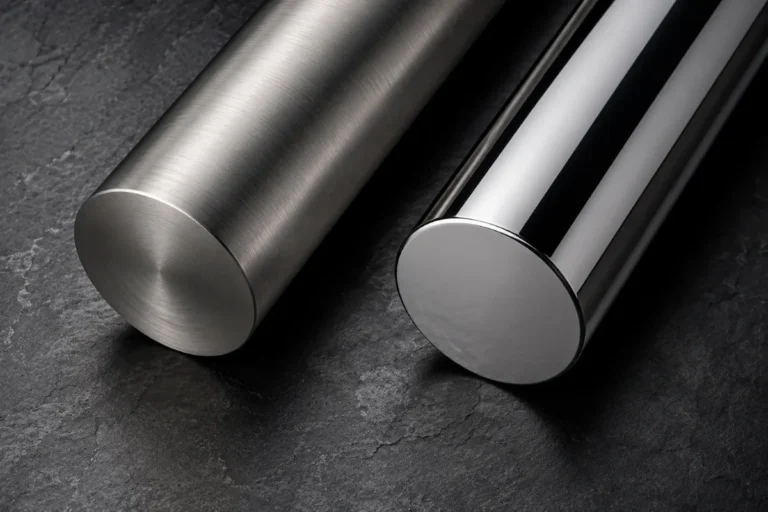
No. 4 (brushed) finish. A finish with fine straight lines and a soft sheen. It hides fingerprints and small scratches well.
Mirror finish. A highly polished, reflective finish. It looks striking but shows every mark. Our guide to stainless steel railing finishes compares the options.
PVD coating. A thin, hard coloured coating applied in a vacuum, used for black, gold and bronze hardware.
Passivation. A chemical treatment that cleans stainless steel and helps rebuild its protective surface layer after fabrication.
Tea staining. Light brown surface marks on stainless steel, usually caused by salt. It is mostly cosmetic but should be cleaned. See our article on stainless steel tea staining.
How to use this glass railing glossary when you order
The terms in a glass railing glossary matter most when you send a request for a quote. The fastest quotes come from buyers who describe the job in the same terms the factory uses. So, when you write to a supplier, include the glass type and thickness, the fixing method (spigot, base shoe, standoff or clamp), top or side mount, the substrate, the grade and the finish. Keep this glass railing glossary open while you write. If you are unsure of a term, send a sketch or a photo as well. It removes most of the guesswork.
We wrote this glass railing glossary because the same questions reach us every week. UNIKIM has more than 20 years of experience making stainless steel railing hardware in Ningbo, China, in AISI 304 and 316, for distributors, contractors and fabricators around the world. You can browse our glass spigots and the full glass railing parts list, or see more of our range on the UNIKIM Made-in-China store.
FAQ
A guard stops people falling from a raised edge, while a handrail is something to hold for support. On many stairs one rail does both jobs, but the codes treat them separately. In this glass railing glossary, the guard is the whole barrier, including glass and fixings, and the handrail is only the rail people grip.
A spigot clamps the bottom edge of a glass panel and stands on the floor or in a core-drilled hole. A standoff bolts through a hole in the glass into the side of a slab or stair. Both are point-fixed systems. Most buyers who use a glass railing glossary for the first time mix these two up, so check the term before you order.
Dry glaze means the glass is held in the base shoe with wedges, shims or a clamping system instead of grout. It allows adjustment during installation and makes it much easier to replace a broken panel later. Wet glaze uses grout or cement and is harder to undo. Both terms appear in this glass railing glossary because suppliers quote them as separate options.
The substrate is what the railing is fixed into, and it decides the anchors, plates and sometimes the hardware itself. Concrete, steel and timber all need different fixings. Giving the substrate early is one of the simplest ways to get an accurate quote, which is why it is one of the most useful words in any glass railing glossary.
Summary
Glass railings use a lot of specialised words, and many of them change from one country to the next. This glass railing glossary covers the main glass types, fixings, code terms, installation words and finishes, so you can read quotes and drawings with confidence. When you order, describe the glass, fixing method, mounting, substrate, grade and finish in these terms, and add a sketch where you can. UNIKIM manufactures glass railing hardware in AISI 304 and 316. To check terms for your project or ask for a quote, contact our team.